

Heart rate variability is one of the most-tracked, least-understood numbers in modern wearables. It shows up daily in your Whoop, Apple Watch, or Garmin data, often labeled as a recovery input — but most people have never had it explained beyond "higher is better." This guide covers what HRV actually measures, why comparing your number to someone else's mostly misses the point, and how it connects to resting heart rate, zone 2 training, and metabolic age.
What HRV actually measures
Heart rate variability is exactly what it sounds like: the variation in time between consecutive heartbeats. That variation reflects the balance between your sympathetic nervous system ("fight or flight") and your parasympathetic nervous system ("rest and digest"). Generally, higher HRV is associated with greater parasympathetic influence, while lower HRV is associated with a higher sympathetic load — which can show up during stress, illness, poor sleep, or overtraining.
Why there's no single "good" HRV number
This is the most important thing to understand about HRV: it is highly individual. Your HRV is shaped by age, genetics, fitness level, and your device's measurement method. What matters is your own trend relative to your own baseline — a meaningful drop from where your HRV typically sits is more useful than any absolute number. Common things that can lower HRV in the short term include poor sleep, alcohol, illness, dehydration, and unusually high training load.
What is a good resting heart rate?
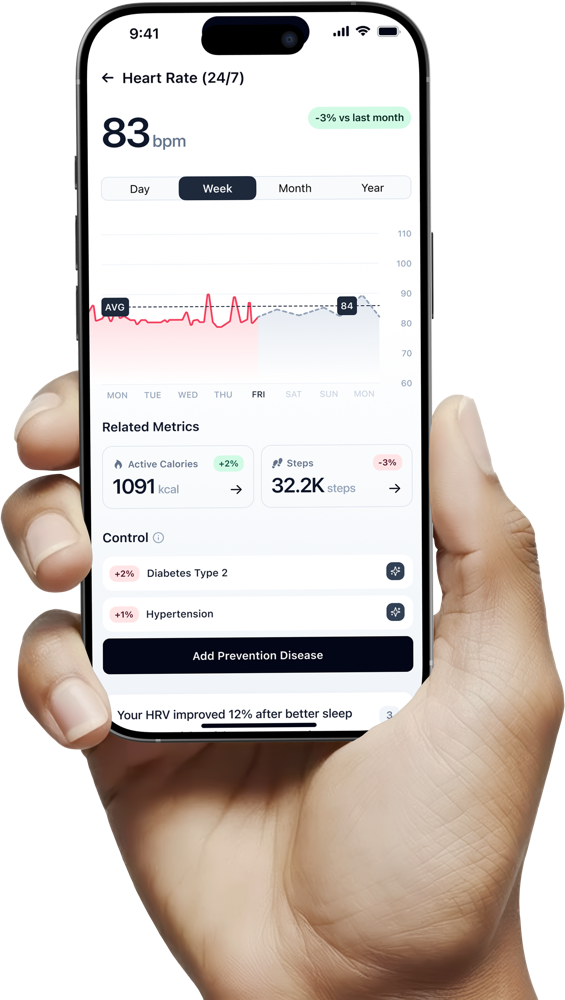
For most adults, a resting heart rate between 60 and 100 beats per minute is considered within the typical range. Well-conditioned athletes often sit meaningfully lower, sometimes in the 40s or 50s. As with HRV, trend matters more than a single reading.
Zone 2 heart rate: the training angle
"Zone 2" refers to a moderate-intensity aerobic training zone, commonly estimated at roughly 60–70% of your maximum heart rate. Training in this zone is associated with building aerobic base fitness and improving your body's efficiency at using fat for fuel. As aerobic fitness improves, resting heart rate and recovery HRV trends often improve alongside it over months of consistent training.
Metabolic age: what it is and what it isn't
Metabolic age is a composite estimate that compares your fitness and metabolic markers to population averages for different chronological ages. It's a motivational framing tool rather than a clinical measurement. For a deeper look at longevity-adjacent metrics, see ONU's guide to biological age.
How HRV connects to stress and sleep
A stressful week often shows up as a lower HRV trend before it shows up anywhere else, and poor sleep tends to suppress HRV recovery overnight. See how cortisol and stress physiology affect HRV and how sleep quality and HRV interact.
How ONU uses your HRV data
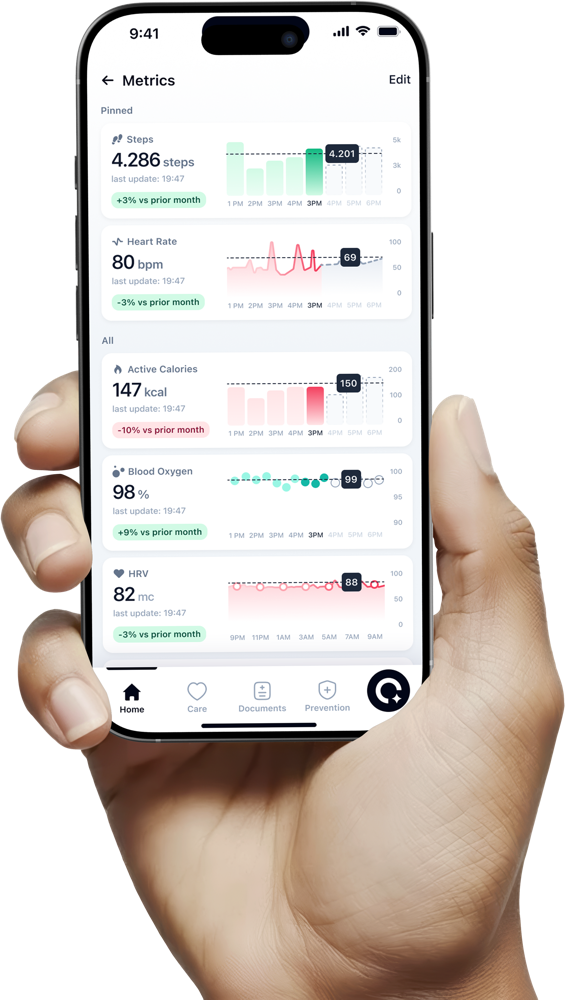
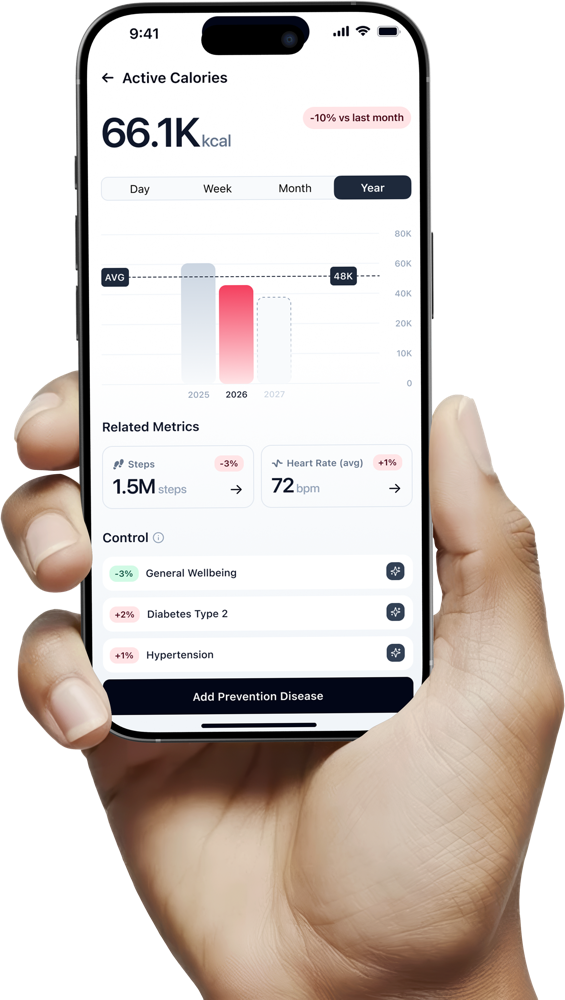
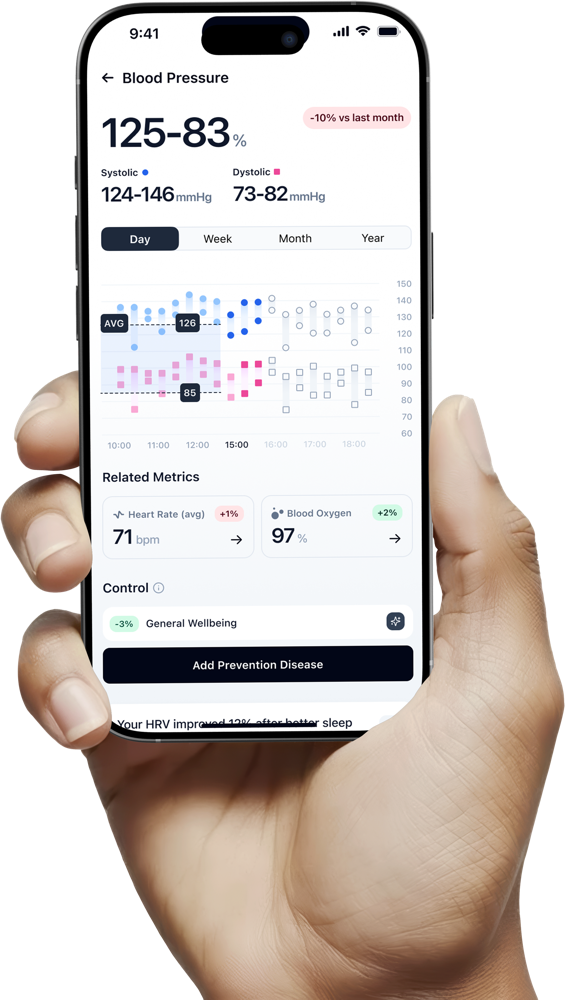
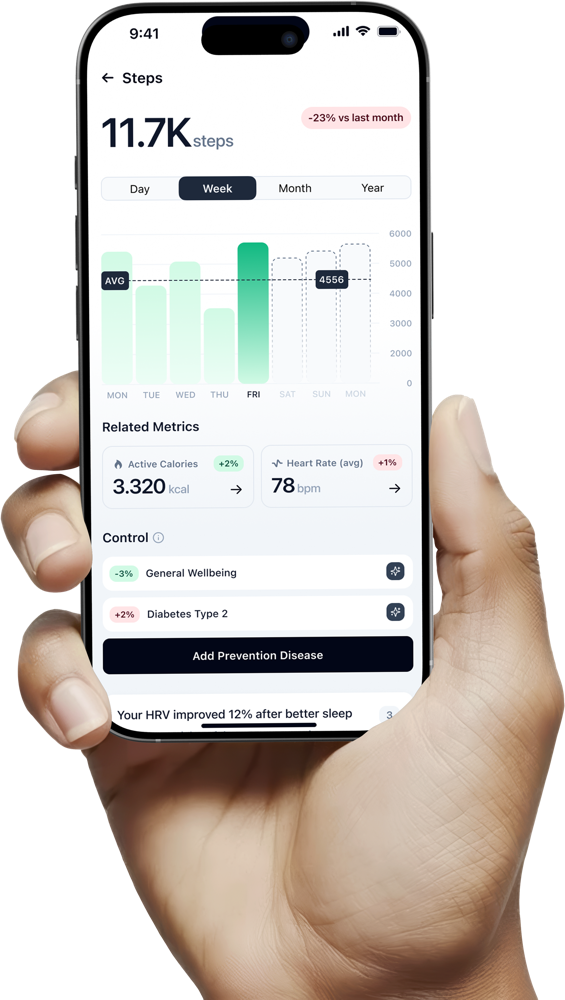
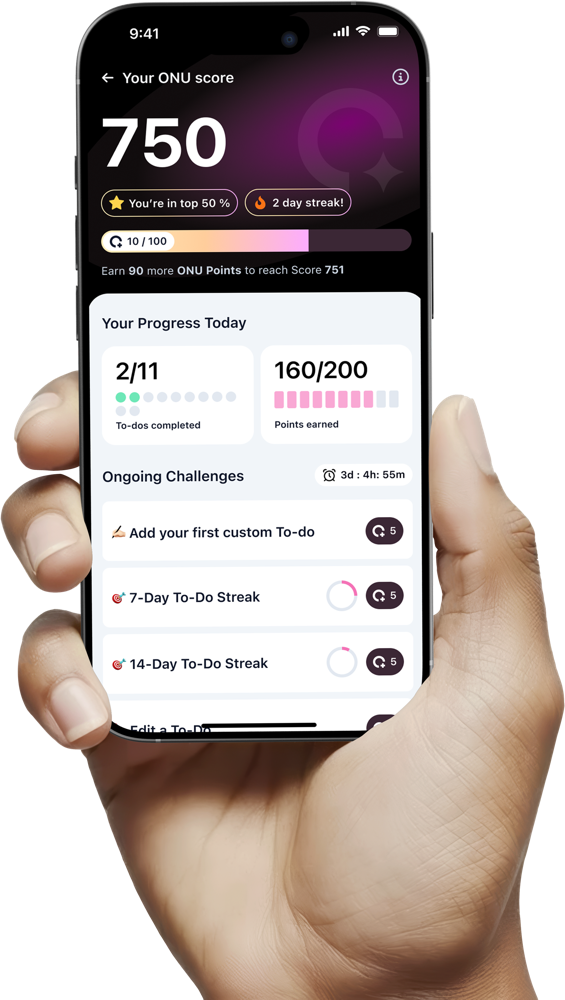
ONU reads HRV directly from Apple Health, Whoop, Garmin, or the ONU Bracelet, and interprets it against your own historical baseline rather than a generic population range. It's one of the core inputs into your daily ONU Score.
HRV and age: what to expect over time
HRV generally trends downward with age as part of normal, expected physiological change, independent of fitness or health status — the more useful comparison remains your own trend relative to your own recent baseline.
Frequently asked questions
Every claim, built on the same foundation
Plain-language, evidence-checked explanations of the biology behind your health data — organized by the kind of question that usually brings people here in the first place.
 1
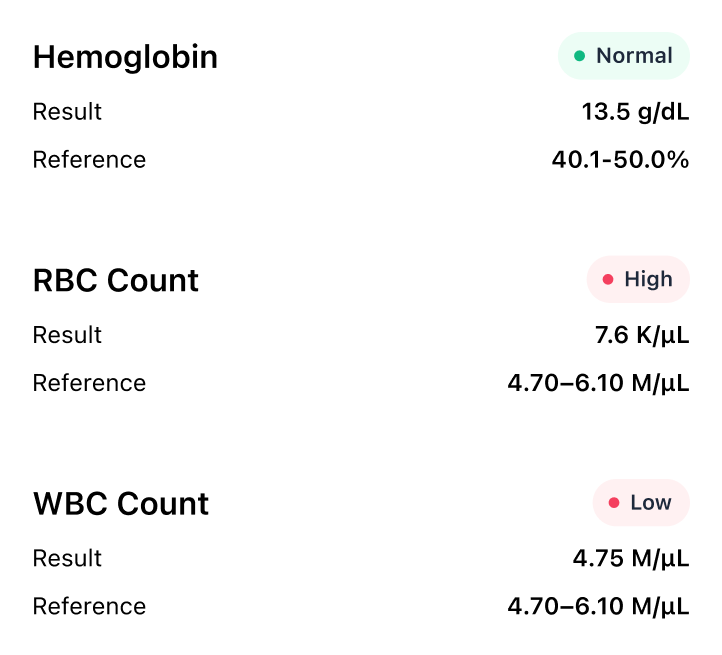
1Blood Test Results Explained
Cholesterol, non-HDL, A1C, and metabolic panels — decoded in plain English, including what a borderline number is actually worth flagging to your doctor.
 2
2Sleep Score Explained
Deep sleep, REM, and why your score moves the way it does — plus research-backed ways to actually improve both, not just chase a higher number.
 3
3Why Am I Always Tired?
Tired but can't sleep, dragging through mornings, waking up unrefreshed — the most common, evidence-backed explanations, in plain language.
 4
4HRV Explained
What heart rate variability measures, what counts as a good resting heart rate, and how HRV connects to zone 2 training and real recovery.
 5
5Cortisol and Stress
What cortisol actually does in your body, what the viral terms get right and wrong, and which foods and supplements genuinely affect stress.
 6
6Acute vs. Chronic Stress
The actual difference between short-term stress and chronic burnout, and whether stress genuinely speeds up aging — without the scare tactics.
 7
7Biological Age Testing
VO2 max, biological age calculators, and the longevity metrics everyone's suddenly discussing — what's evidence-backed, and what's still unproven.
 8
8Full Body Scans & Preventive Checkups
What full-body MRI and CT scans actually involve, what physicians say about screening healthy adults, and where routine tracking fits in between.
 9
9Magnesium & Ashwagandha: A Practical Guide
Which magnesium form actually helps sleep, when to take it, and how much ashwagandha is typically used in studies — no supplement-aisle guesswork.
How this library is built
Every article here goes through the same process: a claim isn't published until it's checked against a primary, authoritative source — the CDC, NIH, WHO, American Diabetes Association, American Heart Association, or peer-reviewed research, depending on the topic — and every article stays inside ONU's wellness-lane guardrail: educational and non-diagnostic, with no disease, treatment, or cure claims anywhere. Where the science is genuinely unsettled or still developing, these guides say so directly, rather than overstating certainty for the sake of a cleaner narrative.
Nothing in this library exists purely as content marketing disconnected from the product. Each article maps directly to something ONU's app actually measures and interprets: the HRV guide explains the exact metric behind your recovery score, the Blood Test Results guide explains the same interpretation logic your uploaded labs go through, and the Cortisol guide explains the physiology behind your daily stress signal. Reading a guide here should make your own ONU Score meaningfully easier to understand, not just deliver abstract information disconnected from your actual data.
If you want a broad orientation rather than jumping straight to one specific question, a reasonable starting sequence is: Blood Test Results Explained (the foundation for understanding any lab work), Sleep Score Explained and HRV Explained (the two most common wearable metrics people misunderstand), then Cortisol and Stress (the physiology behind the terminology dominating health conversations online right now). From there, the remaining guides go deeper into specific, related questions.
See how ONU turns this knowledge into your daily ONU Score in the full product overview.
ACTION
Know it before it happens
ONU provides you with tools to build your healthy future; now it's your time to use them!